

Playing RPGs to master Product Skills
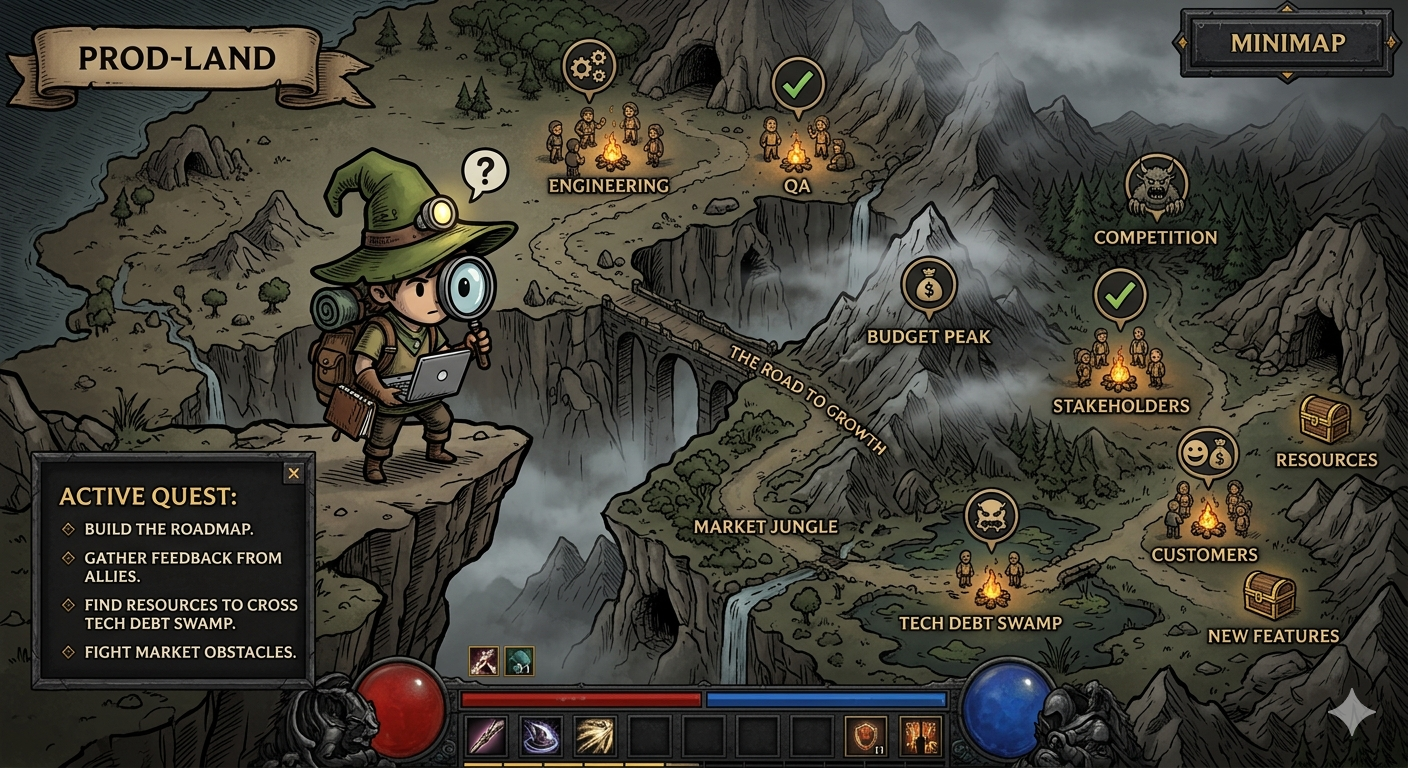
Idea: What does a role-playing game have to do with product management? Might be more than you might think.
At first glance, they seem like two completely different worlds. One is about fantasy, quests, and character growth. The other is about roadmaps, user problems, prioritization, and business outcomes. But once you look a little closer, the overlap becomes surprisingly clear. RPGs are full of the same mental muscles product people use every day: making tradeoffs, learning from incomplete information, adapting strategy, and deciding where to invest scarce resources.
That’s what makes them such a compelling lens for thinking about product skills. In fact, I would argue that playing RPGs can be a low-stakes but highly revealing way to practice product thinking.
Product prioritization as a weighted scorecard
One of the most common tools in product management is the weighted scorecard. You define the criteria, assign relative importance to each one, and then evaluate feature ideas against those criteria. In theory, it sounds clean and rational. In practice, it often becomes a messy, opinion-filled discussion where everyone has a different view of what matters most.
Still, the framework is powerful because it forces clarity. It asks a simple but important question: which feature will create the greatest long-term value, and why?
That same logic shows up in RPGs all the time. You don’t just level up randomly. You decide whether to invest in strength, intelligence, agility, defense, healing, or some other skill based on what kind of character you want to build and what kind of challenges you expect ahead. The player is constantly evaluating options through the lens of the game’s ultimate goal.
That is exactly what product prioritization is. You are not just choosing what is possible. You are choosing what is strategically worth doing now.
Skill trees and product strategy
If you’ve ever played an RPG, you’ve probably seen a skill tree. Sometimes it’s literal, sometimes it’s more abstract, but the idea is the same: you have limited points and many possible paths. Every choice unlocks something while also closing off other options, at least for now.
That dynamic is almost identical to product strategy.
Product strategy is not about doing everything. It’s about deciding which bets are worth making, which capabilities need to be built first, and how to sequence work so the product can grow in a sustainable way. Just like in a game, you cannot max out every skill at once. You need a point of view about the role you want the product to play, the type of user experience you are trying to create, and the business outcomes you are trying to unlock.
A good product manager thinks in systems, but also in sequences. What should happen first? What depends on what? What creates the strongest foundation for the next move? Those are skill tree questions.
Discovery as collecting insights
One of the most useful parts of RPG gameplay is that you are always collecting information. You talk to characters, explore environments, notice patterns, and learn what matters through direct experience. You don’t usually get the full picture all at once. You piece it together over time.
That is a lot like product discovery.
In product work, insights do not come from one perfect conversation or one perfect dashboard. They come from a steady accumulation of observations: user interviews, support tickets, behavior data, sales feedback, implementation notes, and your own product instincts. Each one adds a little more shape to the problem.
The key is not just collecting insights, but knowing what to do with them. In both RPGs and product management, the real challenge is not information scarcity. It is interpretation. Which clues matter? Which signals are noise? What does this mean for the next decision?
That is where product judgment starts to develop. The more you practice, the more you learn how to separate interesting detail from actionable insight.
Resource constraints and delivery
Another strong parallel is how both RPGs and product management force you to work within constraints.
In a game, you have limited points, limited time, limited energy, and usually limited ability to optimize everything at once. You cannot spend all your points on offense if your character also needs survivability. You cannot explore every branch of the story in one playthrough. Tradeoffs are part of the experience.
In product management, the constraints are just as real. Your resources are budget, capacity, timeline, and team attention. Every feature has a cost. Every delay has a cost. Every decision about what to build now is also a decision about what to postpone.
This is why good product work feels so much like strategic gameplay. You are not simply asking, “Can we build this?” You are asking, “Should we build this now, with the resources we have, given the outcomes we want?”
That question is easy to say and hard to answer. But it is the heart of the job.
Character development and product positioning
I also think there is a neat connection between character development in games and product positioning in product work.
In RPGs, character development is not just about getting stronger. It is about becoming more defined. Are you a healer, a fighter, a stealth character, a mage, or some combination? Your identity affects how you play, what choices are available to you, and how others interact with you in the story.
Products have a similar arc.
Product positioning is about defining what the product is for, who it serves, and why it matters. It is the product’s identity. Without clear positioning, a product can become a generic bundle of features that tries to appeal to everyone and ends up being compelling to no one.
The best products, like the best RPG characters, have a strong point of view. They are not everything to everyone. They are designed to solve specific problems in a way that feels distinct and valuable.
That clarity matters because it shapes everything else: roadmap, messaging, feature choices, and even how teams align internally.
What RPGs teach about decision-making
RPGs are full of decision-making under uncertainty. You do not always know what the “right” path is. Sometimes you make a choice, see what happens, and then adapt. That is very similar to product work.
A product manager rarely gets perfect information. You are operating with incomplete data, competing priorities, and changing conditions. You have to choose anyway.
That is one reason I think RPGs can be such a useful mental model. They train you to get comfortable with uncertainty. They remind you that progress often comes from making the best available decision, not the perfect one. They also teach you that reversing course is not failure. It is part of the game.
That mindset is incredibly valuable in product management, where agility and learning are often more useful than rigid certainty.
Collaboration is part of the game
One thing RPGs do especially well is show that no one succeeds alone.
Even if the game centers on one character, there is usually a party, a guild, a team, or some broader system of support. Different characters bring different strengths. Progress depends on coordination, timing, and understanding how the pieces fit together.
That maps very naturally to product management.
A product manager does not ship value alone. You work with engineering, design, data, customer success, sales, support, implementation, and leadership. Your job is often to help those different perspectives work together around a shared goal.
That means listening carefully, translating between functions, and creating enough clarity that the team can move without unnecessary friction. In RPG terms, you are the one helping the party stay aligned on the quest.
Why this matters for teaching product
I think this comparison is especially useful for people who are not already in product management.
A lot of product concepts can feel abstract when they are introduced in a purely business context. Prioritization frameworks, user research, roadmaps, and tradeoff analysis can sound technical or overly corporate. But when you compare them to a game that already feels intuitive, the ideas become much easier to grasp.
RPGs can make product thinking feel more human.
They show that product management is not just about templates or meetings. It is about choices, growth, resources, and consequences. It is about understanding the system you are inside and making smart moves inside that system.
That is a much more relatable way to learn than starting with jargon.
What I notice about my own style
By far, my favorite part of this comparison is what it reveals about self-management.
When I play an RPG, I naturally start noticing my own patterns. Do I optimize too early? Do I overinvest in one path? Do I explore enough before making decisions? Do I adapt when new information appears, or do I try to force the original plan?
Those questions are not just about the game. They are about how I think.
And that is why RPGs can be so useful from a product perspective. They create a visible, low-risk environment where your habits show up clearly. You can see whether you are patient, strategic, reactive, flexible, or overly fixed on one outcome. That kind of reflection is incredibly valuable for anyone trying to grow as a product person.
Sometimes the best learning does not come from a workshop or a framework. It comes from noticing how you behave when there is a quest in front of you and only a limited number of points to spend.
Closing thoughts
Playing RPGs can be a fun and surprisingly practical way to introduce product management to someone outside the industry. It gives people an intuitive way to practice decision-making, problem-solving, collaboration, and prioritization without needing to start with business terminology.
More importantly, it offers a way to reflect on how you think.
And that may be the most useful product lesson of all: understanding your own approach to uncertainty, tradeoffs, and growth. Whether you are building a character or building a product, the underlying question is similar:
“How do you make the best possible choices with the resources you have, in service of a larger goal?”
That, to me, is where the real overlap lives.